
Master skating first—spend 15 minutes daily on forward strides, stopping in both directions, and backward skating to build the foundation every other skill depends on. Without confident skating, you’ll struggle to position yourself, pursue the puck, or execute plays effectively.
Develop proper stick handling by practicing with your head up, keeping the puck in constant motion using soft hands, and working both your forehand and backhand equally. Start with stationary drills, then progress to moving patterns that simulate game situations.
Practice shooting mechanics using the “sweep, shift, snap” method: sweep the puck toward your body, shift your weight from back foot to front, and snap your wrists through the release point. Begin five feet from the net to perfect your form before increasing distance.
Learn positional awareness by studying where to stand in defensive and offensive zones, understanding when to support teammates versus create space, and recognizing passing lanes before they open. This hockey IQ separates effective players from those who simply chase the puck.
Commit to deliberate practice rather than mindless repetition. Quality repetitions with proper technique build muscle memory faster than hundreds of careless attempts. Focus on one skill per session, record yourself to identify flaws, and seek feedback from experienced players or coaches who can correct bad habits before they become permanent.
The difference between players who progress rapidly and those who plateau isn’t natural talent—it’s systematic skill development combined with consistent effort. These five fundamental skills create the framework for everything else you’ll learn in hockey.
Why Fundamentals Matter More Than Flash
Walk into any hockey rink during an NHL practice, and you’ll witness something that might surprise you: the world’s best players spending significant time on basic skating drills, simple passing exercises, and fundamental stick handling. If professionals who’ve mastered the game still dedicate daily practice time to the basics, why do so many beginners rush past these foundational skills?
The temptation is understandable. Highlight-reel moves and advanced techniques look exciting, and it’s natural to want to emulate your favorite players. However, attempting between-the-legs dekes before you can execute a proper forehand pass is like trying to run before you can walk. You’re building your game on an unstable foundation that will eventually limit your progress.
Professional players understand a critical truth: fundamentals are not stepping stones you leave behind as you advance. They are the bedrock of every successful play you’ll ever make. When Sidney Crosby practices edge work or Connor McDavid refines his crossovers, they’re reinforcing the muscle memory and body positioning that allows them to execute advanced moves under game pressure.
The connection between solid fundamentals and long-term development is straightforward. Each basic skill you master expands your capability to learn more complex techniques. A player with excellent skating balance can more easily learn to receive passes while in motion. Someone who’s perfected their grip and basic stick handling will find advanced puck control far more accessible.
Think of fundamental skills as your hockey vocabulary. The larger and more refined your basic skill set, the more fluently you’ll play the game. Rushing through the basics might get you on the ice faster, but investing time in proper foundational training creates a player who’s genuinely prepared to grow. The most successful players aren’t those who knew the flashiest moves earliest, but those who built unshakeable fundamentals they could rely on throughout their careers.
Skating: Your Foundation for Everything Else
Forward Skating Technique
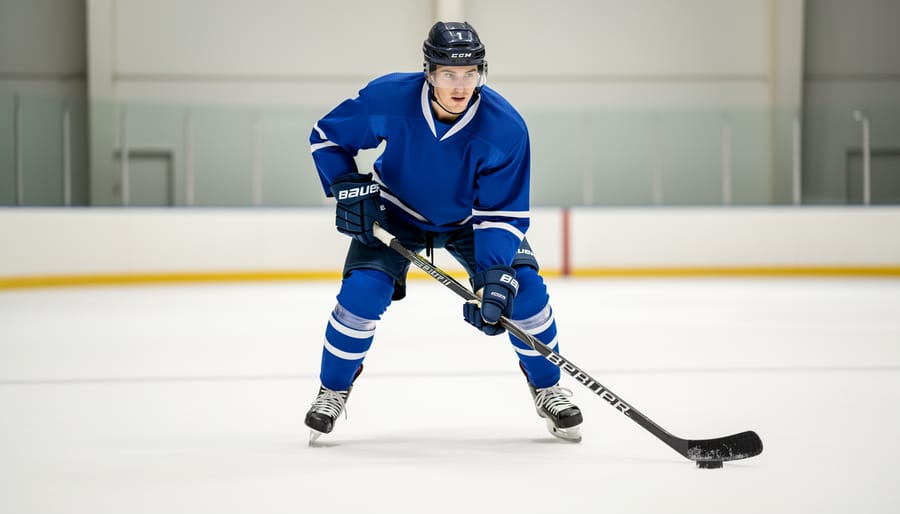
Mastering forward skating starts with establishing the proper athletic stance. Begin with your knees bent at roughly 90 degrees, weight centered over the balls of your feet, and your chest up with eyes looking forward. This foundation allows for powerful, controlled strides.
The stride itself follows a specific sequence. Push off with one skate at a 45-degree angle to your direction of travel, driving through the inside edge while extending your leg fully. As you push, transfer your weight completely to your gliding skate. Your pushing foot should finish with the toe pointed outward, creating a C-cut pattern in the ice. Return the pushing leg underneath your body in a controlled recovery motion before initiating the next stride.
Edge work is crucial for effective skating. Focus on pressing into the inside edge of your pushing skate while maintaining balance on the flat or slight inside edge of your gliding foot. This creates the grip needed for powerful acceleration.
Common mistakes include keeping legs too straight, which eliminates power generation. If you’re not bending deeply enough, practice wall sits off-ice to build strength and muscle memory. Another frequent error is pushing straight back instead of at an angle, reducing efficiency dramatically. Film yourself or have a coach observe your stride angle.
Many beginners also fail to complete the full leg extension or rush the recovery phase. Remember, quality over speed. Each stride should be deliberate and complete. Practice one-leg glides between strides to develop balance and ensure you’re achieving full weight transfer. With consistent practice focusing on these fundamentals, your skating efficiency will improve rapidly.
Backward Skating and Transitions
Backward skating might feel awkward initially, but it’s an essential skill that opens up defensive play and overall ice mobility. Start by finding your balance in the backward stance. Bend your knees slightly more than you would for forward skating, keep your chest up, and maintain your weight centered over your skates.
The C-cut technique forms the foundation of backward skating. Push one skate out in a C-shaped motion while the other glides, then alternate. Begin with small C-cuts near the boards for support, gradually increasing the size and power of each push as you gain confidence. Your shoulders should remain square, and avoid the common mistake of looking down at your feet.
Transitions between forward and backward skating separate proficient players from beginners. The mohawk turn is your starting point. While skating forward, pivot on one foot while bringing the other foot parallel in the opposite direction, transferring your weight smoothly. Practice this transition repeatedly in both directions until it becomes second nature.
For effective practice, try these progressive drills. First, perform stationary C-cuts while holding the boards for 2-minute intervals. Next, practice backward skating across the width of the ice, focusing on maintaining straight lines. Finally, set up cones in a zigzag pattern and practice transitioning from forward to backward skating at each cone.
Dedicate 10-15 minutes of each ice session to backward skating drills. Consistency builds the muscle memory and confidence needed to execute these movements instinctively during game situations. Remember, every skilled player once struggled with skating backward.
Stickhandling: Control the Puck, Control the Game
Grip and Hand Position
Your grip fundamentally determines how well you control the puck, so getting it right from the start is essential. Begin by placing your top hand near the top of the stick, just below the shaft’s end. Your bottom hand should rest 10-15 inches down the shaft, though this distance varies based on your height and comfort.
Hold the stick with a relaxed grip using your fingers more than your palms. Many beginners make the mistake of squeezing too tightly, which actually reduces control and causes fatigue. Think of holding the stick like you would a hammer when doing light work—firm enough to control it, but loose enough to maintain flexibility. Your top hand guides and controls stick movement, while your bottom hand provides power and leverage.
The V-shape created by your thumb and index finger on your top hand should point down the shaft. Your bottom hand mirrors this positioning. As you practice, you’ll notice how sliding your bottom hand up the shaft gives you better stickhandling control in tight spaces, while moving it down generates more power for shooting. This adjustability is key—elite players constantly adjust their hand position based on the situation, and developing this habit early will accelerate your progress significantly.
Basic Dribbling and Puck Feel
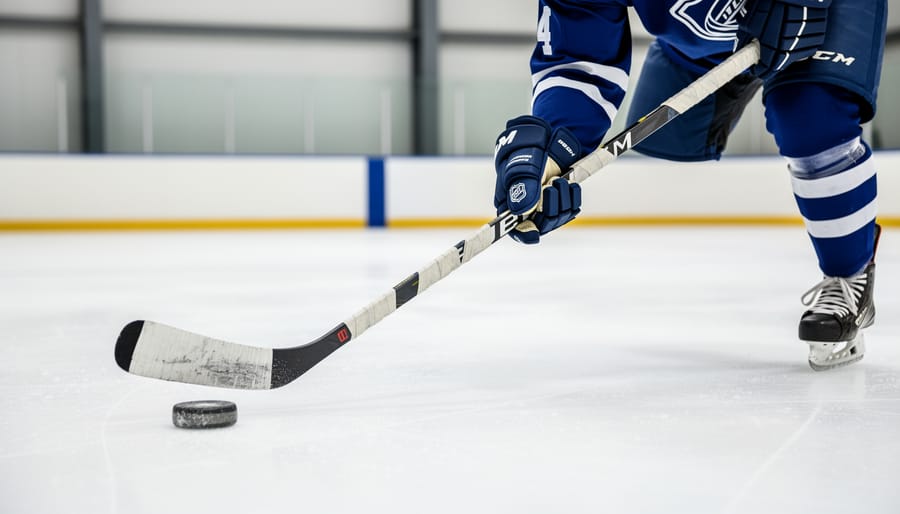
Developing soft hands starts with understanding that puck control is about gentle, consistent contact rather than gripping your stick tightly. Begin by holding your stick with relaxed hands, allowing your top hand to guide while your bottom hand provides support and control.
Start with stationary puck handling. Place a puck in front of you and practice moving it side-to-side in a smooth figure-eight pattern around your body. Keep the puck close to your blade, making small controlled movements. Practice this for 5-10 minutes daily until the motion becomes automatic. Focus on keeping your head up periodically, building the awareness you’ll need during gameplay.
Progress to the toe-drag exercise, where you pull the puck from your forehand to backhand using only the toe of your blade. This builds the delicate touch essential for advanced stickhandling. Execute 20 repetitions on each side during practice sessions.
For off-ice training, use a stickhandling ball or golf ball on smooth surfaces like concrete or plywood. The smaller, lighter ball demands more precision and directly translates to improved on-ice performance. Practice the same figure-eight patterns and add obstacles like cones or household items to navigate around.
The cup drill offers immediate feedback for puck awareness. Set up plastic cups in a line and stickhandle through them without knocking any over. This teaches you to control the puck’s distance from your body while maintaining soft hands.
Dedicate 15-20 minutes daily to these exercises, splitting time between on-ice and off-ice training. Consistency builds muscle memory faster than occasional lengthy sessions, and within weeks you’ll notice significantly improved puck control during games.
Passing: The Most Underrated Skill You’ll Learn
The Forehand Pass
Mastering the forehand pass is essential for moving the puck efficiently and creating scoring opportunities. This fundamental skill forms the backbone of team play and is one of the first passes you’ll use in game situations.
Start by positioning your hands properly on the stick, with your top hand about halfway down the shaft and your bottom hand near the middle. Place the puck on the middle of your blade, slightly closer to the heel than the toe. This positioning gives you maximum control and power.
As you prepare to pass, shift your weight to your back foot. Your body should be turned slightly toward your target, with the puck positioned beside your back skate. This weight distribution creates the energy you’ll transfer into the pass.
Execute the pass by sweeping the puck forward in a smooth motion while transferring your weight from back foot to front foot. Keep your blade cupped over the puck throughout the entire motion to maintain control and prevent it from lifting off the ice. Your top hand pulls while your bottom hand pushes, creating a fluid pushing motion.
The follow-through is critical for accuracy. Point your blade directly at your target after releasing the puck, similar to pointing where you want a basketball to go. This natural aiming mechanism dramatically improves precision. Practice passing to a specific spot on the boards or a teammate’s stick blade, gradually increasing distance as your accuracy improves.
Receiving Passes Under Pressure
Receiving passes under pressure separates confident players from those who panic when opponents close in. The key is preparing your stick and body before the puck arrives.
Start by positioning your body between the defender and the puck. Keep your knees bent and weight centered, creating a shield with your positioning. As the pass approaches, angle your stick blade to cushion the puck’s impact. Think of your blade as a pillow—give slightly when contact occurs rather than presenting a rigid surface that causes bounces.
Your hands should be relaxed but controlled. Grip tension causes the puck to bounce off your blade, while soft hands absorb the energy. Practice receiving passes with your bottom hand loose enough to allow the stick to give slightly backward upon contact.
Maintain constant head movement, scanning for both the incoming pass and approaching checkers. Use your peripheral vision to track defensive pressure while keeping eyes on the puck during reception.
For developing these skills, try the pressure reception drill. Have a partner send passes while another player applies light defensive pressure from different angles. Focus on clean receptions first, then gradually increase defensive intensity. Another effective exercise is the one-touch control drill, where you receive passes against the boards with a teammate immediately pressuring you, forcing quick puck control and protection.
Practice receiving passes on your forehand and backhand equally. Comfort from both sides makes you unpredictable and harder to defend against tight coverage.
Shooting: Put the Puck Where You Want It
Wrist Shot Mechanics
The wrist shot is your go-to weapon for quick, accurate scoring opportunities. Mastering this fundamental shot begins with proper hand positioning—your top hand should grip the stick firmly about halfway up the shaft, while your bottom hand sits 12-18 inches below, creating leverage for power generation.
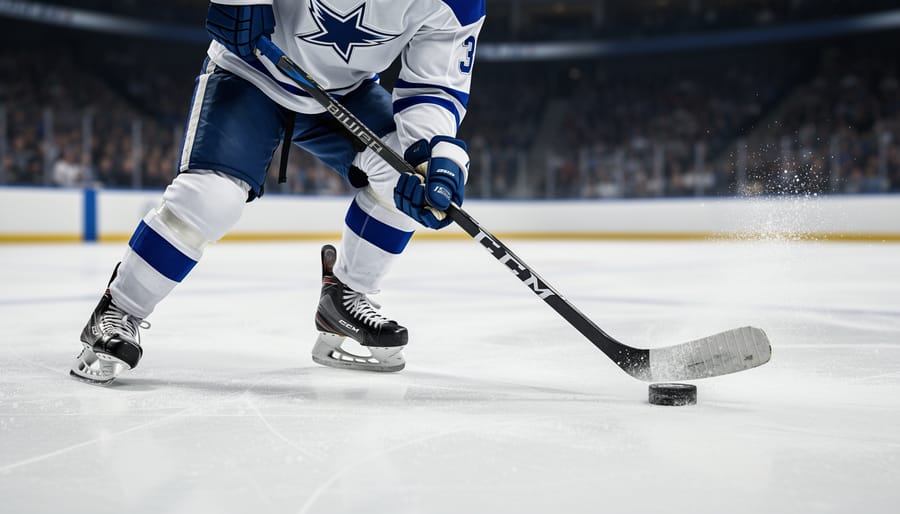
Position the puck slightly forward of your back foot, keeping it in the middle portion of your blade. This starting point allows for maximum control during the shooting motion. The key to an effective wrist shot lies in smooth weight transfer. Start with your weight on your back foot, then shift forward through your front foot as you pull the puck toward the net. This weight shift generates the power, not just your arms.
As you sweep the puck forward, roll your wrists over to cup the blade slightly, creating the characteristic snap that gives the shot its velocity. Your follow-through should point directly at your target, with the blade finishing high—this ensures accuracy and proper puck rotation.
Common mistakes include keeping weight on the back foot, which drains power, or starting with the puck too far back in your stance. New players often rush the motion, sacrificing the smooth sweep that creates velocity. Focus on one fluid movement rather than separate, jerky motions. Practice this motion repeatedly without a puck first, ingraining the proper mechanics before adding shooting pressure.
Accuracy Before Power
New players often make the mistake of trying to fire the puck as hard as possible before mastering basic accuracy. This approach leads to wild shots that miss the net entirely and slow your overall development. Think of it like learning to write—you master forming letters before developing speed.
Start with stationary target practice just five feet from the net. Place visual markers in each corner and aim for specific spots with ten shots per target. Focus on blade position at release and follow-through direction rather than shot velocity. As your accuracy improves to seven out of ten hits, gradually increase your distance by two-foot increments.
Progressive shooting drills build on this foundation. Begin with wrist shots from the slot, concentrating solely on hitting designated net areas. Once comfortable, add movement by receiving passes before shooting, maintaining that same accuracy focus. Expert coaches recommend this sequence because muscle memory developed through precise, controlled repetitions translates directly to game situations. Speed naturally develops as proper technique becomes automatic, but rushing this process creates bad habits that require extensive correction later.
Body Positioning and Hockey Sense
Understanding body positioning and hockey sense transforms you from someone who simply skates on ice into a true hockey player. These foundational concepts help you read the game, anticipate plays, and use your body effectively regardless of your size or strength.
Spatial awareness begins with keeping your head up. Develop the habit of scanning the ice every few seconds, tracking both the puck and player positions. Practice this during skating drills by calling out what you see—teammates’ locations, open ice, or opponent positions. This awareness allows you to make smarter decisions before the puck even reaches your stick.
Your defensive stance forms the cornerstone of effective positioning. Stand with knees bent, weight centered over your skates, and stick on the ice in front of you. Keep your shoulders square to the opponent and maintain an arm’s length distance. This athletic position allows you to react quickly in any direction while staying balanced.
Angling is the art of using your positioning to guide opponents away from dangerous areas. Instead of chasing the puck carrier, skate to cut off their path to the net or center ice. Imagine drawing a line between the opponent and their destination—position yourself on that line. Guide them toward the boards or away from scoring chances using your body as a barrier, not a weapon.
Practice body positioning through simple drills. Set up pylons as “opponents” and practice maintaining proper gap control—staying close enough to pressure them but far enough to react to moves. Work with a partner where one player tries to reach a specific area while the defender uses only positioning and angling to prevent it.
Remember, effective body positioning beats pure physicality every time. Smart positioning keeps you in the play and makes you a reliable defensive presence.
Your First 30 Days: A Practice Roadmap
Your first month is crucial for building a strong foundation. This roadmap balances on-ice practice with off-ice conditioning, giving you the structure needed to develop all five fundamental skills simultaneously.
Week 1: Foundation Phase
Dedicate three 45-minute sessions to basics. Spend 15 minutes on skating drills focusing on balance and stopping, 10 minutes practicing basic stick handling in stationary positions, 10 minutes on wrist shot mechanics without a puck, and 10 minutes reviewing positioning concepts through video or coaching instruction. Off-ice, practice stick handling for 10 minutes daily at home using a golf ball or specialized training ball.
Week 2: Building Coordination
Increase to four sessions of 60 minutes each. Now combine skills: practice stick handling while skating in straight lines (15 minutes), work on passing against the boards (15 minutes), and incorporate basic shooting drills with proper form (15 minutes). Your benchmark is completing three consecutive crossovers on each side and maintaining control while stick handling at slow speeds. Off-ice training should include 15 minutes of stick handling plus bodyweight exercises for leg strength three times weekly.
Week 3: Adding Complexity
Continue four 60-minute sessions but increase intensity. Practice tight turns while maintaining puck control, execute give-and-go passes with a partner, and work on shooting accuracy from various distances. You should now stop confidently on both sides and complete basic passing sequences without losing the puck. Introduce game situation awareness drills for the final 10 minutes of each session.
Week 4: Integration and Assessment
Test your progress through small-area games that combine all skills. Your benchmarks: skate backward comfortably, complete controlled crossovers at moderate speed, stick handle through a simple obstacle course, pass accurately to a moving target, and shoot with consistent technique. Celebrate these achievements while identifying areas needing continued focus beyond your first month.
Building a strong foundation in hockey takes time, dedication, and patience. Remember that mastering these fundamental skills isn’t something you accomplish once and check off your list. Even professional players continue refining their skating, stickhandling, passing, shooting, and positioning throughout their entire careers. The difference between where you are now and where you want to be lies in consistent, focused practice.
Don’t get discouraged if progress feels slow at times. Every player who makes the game look effortless today once struggled with their first crossovers or fumbled passes during drills. The key is showing up regularly, maintaining proper technique even when you’re tired, and celebrating small improvements along the way. Set realistic goals for yourself, whether that’s completing the 30-day practice plan we’ve outlined or simply committing to three focused practice sessions per week.
As you continue your hockey journey, seek out additional resources to accelerate your development. Quality instruction makes a significant difference in how quickly you progress and helps you avoid developing bad habits that become harder to correct later. Consider working with experienced coaches who can provide personalized feedback and help you address specific weaknesses in your game.
Your hockey education doesn’t end here. We offer comprehensive training programs, detailed skill breakdowns, and expert guidance designed specifically for players at every stage of development. Take the next step in your progression by exploring our full range of training resources and finding the program that matches your goals and current skill level.