
Build explosive power through barbell deadlifts, trap bar carries, and Bulgarian split squats twice weekly during the off-season. Hockey demands strength in positions you won’t find in a bodybuilding magazine. Your legs need to generate force while you’re bent at the waist, knees flexed, pushing laterally against resistance. Focus on multi-joint movements that mirror on-ice positions rather than isolated muscle work.
Develop game-ready conditioning with high-intensity interval training that matches hockey’s unique energy demands. A typical shift lasts 45 seconds of near-maximal effort. Structure your cardio around 30-45 second sprints followed by 90-120 seconds of active recovery. This builds the anaerobic capacity essential for competing hard when you’re gassed in the third period.
Master rotational core exercises like Pallof presses, medicine ball slams, and anti-rotation holds. Every shot, every check, every stride involves your core transferring force through rotation. A strong core doesn’t just prevent injury. It directly translates to harder shots and more powerful skating strides.
Prioritize hip mobility work daily, even on rest days. Tight hips restrict your stride length and skating mechanics, limiting speed regardless of leg strength. Spend ten minutes on 90/90 stretches, frog stretches, and hip flexor mobility before every workout.
The connection between gym performance and ice performance isn’t automatic. You need to train movements that support fundamental hockey skills rather than chasing generic fitness goals. This guide breaks down exactly which exercises translate to better skating, harder shots, and winning more battles along the boards.
Why Hockey Players Need Sport-Specific Exercise
Hockey isn’t like jogging or lifting weights at your local gym. The sport demands a combination of explosive power, quick decision-making under fatigue, and the ability to recover rapidly between high-intensity shifts lasting 30-80 seconds. Without training that mirrors these specific demands, you’re preparing your body for the wrong game.
General fitness might get you through recreational skates, but competitive hockey requires your muscles to fire in patterns you won’t replicate on a treadmill. Every stride on the ice involves lateral push-offs that stress your hip abductors and adductors differently than running. Quick directional changes test your ability to decelerate and reaccelerate in milliseconds. Physical contact along the boards demands core stability that a standard plank simply doesn’t build.
Sport-specific training directly translates to better on-ice performance. Exercises that target the posterior chain help you generate more power through your skating stride. Rotational core work improves your shot velocity and checking ability. Plyometric training reduces the time your skate blade spends on the ice during each push, making you faster.
Beyond performance gains, targeted training addresses hockey’s unique injury risks. Studies show that resistance training reduces injury risk by strengthening the muscles, tendons, and ligaments that protect your joints during aggressive play. Proper hip mobility work prevents groin strains. Shoulder stabilization exercises reduce the likelihood of separation from board contact.
Players who commit to hockey-specific training extend their careers by maintaining the speed and power needed to compete as they age. You’re not just building fitness. You’re teaching your body the exact movements it needs to dominate on the ice.
Building Your Foundation: Strength Training for Hockey
Lower Body Power Exercises
Building explosive skating power starts with developing strength in your posterior chain and legs through targeted exercises that translate directly to the ice.
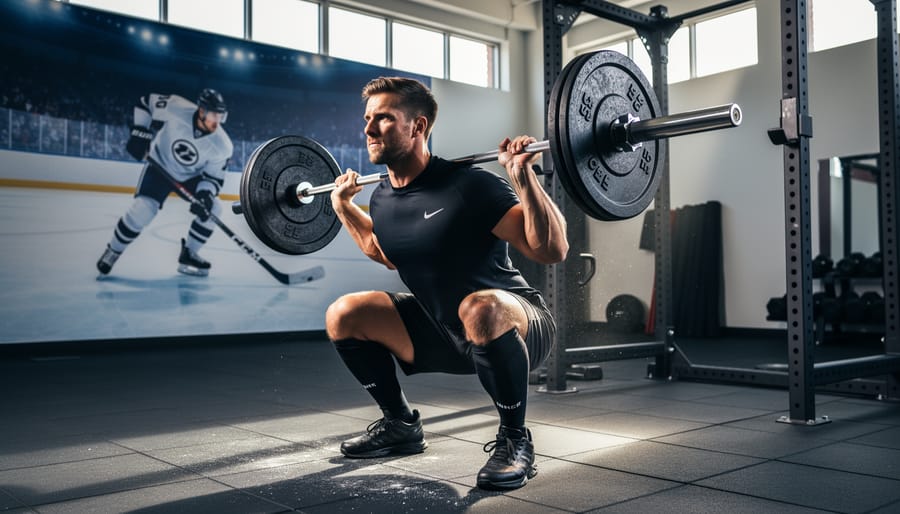
Squats form the foundation of any hockey strength program. Whether you’re performing back squats, front squats, or goblet squats, focus on depth and control. Descend until your thighs are parallel to the ground (or slightly below if mobility allows), keeping your chest up and core braced. This mimics the knee and hip angles you hold during skating strides, building the exact muscles you need for powerful pushes.
Deadlifts develop the hamstrings, glutes, and lower back that drive every explosive movement on the ice. Start with conventional deadlifts to master the hip hinge pattern, then progress to Romanian deadlifts for enhanced hamstring engagement. Keep the bar close to your body throughout the movement and drive through your heels.
Single-leg exercises deserve special attention because hockey demands unilateral strength and balance. Bulgarian split squats challenge each leg independently while improving hip stability. Position your rear foot on a bench, descend until your front thigh is parallel, then drive powerfully through your heel. This exercise mirrors the single-leg loading pattern of skating better than almost any other movement.
Step-ups build the same powerful hip extension you use pushing off each stride. Use a box height that creates a 90-degree knee angle at the top position. Drive through your entire foot, not just your toes, and fully extend your hip at the top.
Single-leg Romanian deadlifts add a balance component that translates directly to maintaining stability during skating transitions. Start with bodyweight only, then progress to holding dumbbells as your balance improves. These exercises collectively create the explosive strength that separates average skaters from dominant ones.
Core Stability and Rotational Strength
Your core is the foundation of every powerful stride, shot, and check on the ice. A strong, stable midsection doesn’t just help you generate more force through the puck, it keeps you balanced through contact, protects your spine during thousands of directional changes per game, and creates the platform for explosive movements.
The key distinction for hockey players is anti-rotation work. While traditional crunches and sit-ups have limited carryover to the ice, exercises that resist unwanted movement build the functional strength you need. Think Pallof presses, dead bugs, and bird dogs. These teach your core to stay solid while your limbs move independently, which translates directly to maintaining your shooting position under pressure or keeping your balance when you’re being leaned on in the corners.
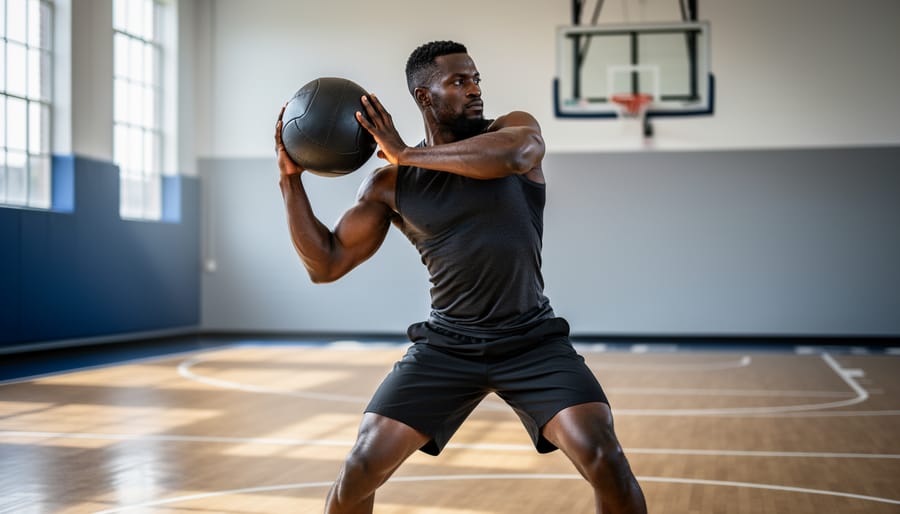
Research on core stability training programs shows measurable improvements in skating performance and reduced injury risk. Dynamic core exercises take this further. Med ball rotational throws mimic the torque generation of a slap shot. Landmine rotations build the twisting power you need for quick passes and dekes. Cable chops in various angles develop the ability to generate force from compromised positions, which happens constantly in game situations.
For immediate implementation, add three anti-rotation exercises to your warm-up routine: front planks with alternating shoulder taps, side planks with hip dips, and half-kneeling Pallof presses. Hold or press for 30-45 seconds per side. Your on-ice performance will improve faster than you think.
Upper Body and Grip Strength
Upper body strength separates good players from great ones on the ice. Your ability to fire powerful shots, win board battles, and maintain puck control all depends on developing balanced strength through your shoulders, back, chest, and forearms.
Focus on maintaining a 2:1 ratio of pulling to pushing exercises. Hockey players naturally develop strong chest and shoulder muscles from shooting and checking, but neglecting your back leads to rounded shoulders and decreased performance. Incorporate bent-over rows, inverted rows, and pull-ups as your foundation. These build the posterior chain strength needed for explosive slap shots and maintaining proper posture during long shifts.
For pushing movements, overhead presses and push-up variations develop the shoulder stability required for absorbing checks and protecting the puck. Single-arm dumbbell presses are particularly effective since they mirror the asymmetrical demands of stick handling.
Don’t overlook grip strength. Your hands connect everything to your stick. Dead hangs, farmer’s carries, and plate pinches dramatically improve stick handling endurance and shot accuracy. Try holding a heavy dumbbell in each hand and walking for 40 yards. Your forearms will burn, but your stick skills will thank you.
Aim for three upper body sessions weekly during the off-season, dropping to two during the competitive season to avoid fatigue.
Conditioning That Mirrors Game Demands
High-Intensity Interval Training (HIIT) for Hockey
High-Intensity Interval Training mirrors the explosive nature of hockey shifts better than any other conditioning method. The average shift lasts 30 to 45 seconds of all-out effort followed by rest on the bench. Your HIIT sessions should replicate this exact demand.
The foundation of effective hockey HIIT lies in the work-to-rest ratio. Start with a 1:3 ratio, meaning 30 seconds of maximum effort followed by 90 seconds of active recovery. This builds your anaerobic capacity while allowing enough recovery to maintain quality throughout the session. As your conditioning improves over 4-6 weeks, progress to 1:2 ratios, then eventually 1:1 for advanced players.
Here’s how to structure a hockey-specific HIIT session:
- Complete a 10-minute dynamic warm-up including leg swings, lunges, and light skating or jogging to prepare your muscles and elevate your heart rate.
- Begin with 6-8 intervals of 30 seconds maximum effort (think game-speed skating intensity) followed by 90 seconds of easy movement like walking or slow skating.
- Focus on explosive movements during work intervals: sprint starts, lateral crossovers, or transition drills that replicate game situations.
- Monitor your recovery between intervals. You should reach approximately 60-70% of your max heart rate before starting the next interval.
- Cool down with 5-10 minutes of light movement and static stretching to promote recovery.
According to strength coach Maria Sanchez, who works with junior and collegiate hockey programs, “The biggest mistake players make is going too hard too soon. Start conservative with your interval count and gradually add one or two intervals each week.”
Perform HIIT sessions 2-3 times per week during off-season training, reducing to once weekly during the competitive season. Space these sessions at least 48 hours apart to allow proper recovery. The goal isn’t to exhaust yourself but to train your body’s energy systems to recover quickly between shifts, just like game conditions demand.
Building Your Aerobic Base
Most hockey players spend hours perfecting their explosive power and sprint speed, but here’s what many miss: aerobic fitness is the foundation that lets you recover between those intense bursts. Without a solid aerobic base, you’ll dominate the first period and fade by the third.
Think of aerobic conditioning as your recovery engine. Between shifts, your heart rate needs to drop quickly. During tournaments with multiple games in a weekend, your aerobic system clears metabolic waste and helps you bounce back. Players with better aerobic capacity don’t just last longer in games. They maintain their skating speed, make smarter decisions under pressure, and avoid the mistakes that come with fatigue.
The challenge is building this base without compromising your power. You’re not training for a marathon. Your goal is developing an efficient cardiovascular system that supports high-intensity efforts.
Start your off-season with 20-30 minutes of low-intensity cardio three times weekly. Keep your heart rate at 60-70% of maximum. Cycling works well because it spares your joints after a long season. Swimming is another excellent option. As you move closer to the season, reduce the duration but maintain the frequency.
Here’s a practical test: Can you hold a conversation during your aerobic sessions? If you’re gasping for air, you’re working too hard. This isn’t about crushing yourself. Save that intensity for sprint work and on-ice training.
Many strength coaches recommend morning aerobic sessions on non-lifting days. This timing prevents interference with your power development while still building your recovery capacity. During the season, one 20-minute session per week maintains what you’ve built without adding excessive training stress.
Your aerobic base won’t make highlight reels, but it’s what separates players who finish strong from those watching from the bench in crucial moments.
Speed and Agility Training Off the Ice
Your explosive first three steps on the ice can make the difference between beating a defender or getting caught from behind. The good news? You can develop that acceleration and agility in your training shoes before you ever lace up your skates.
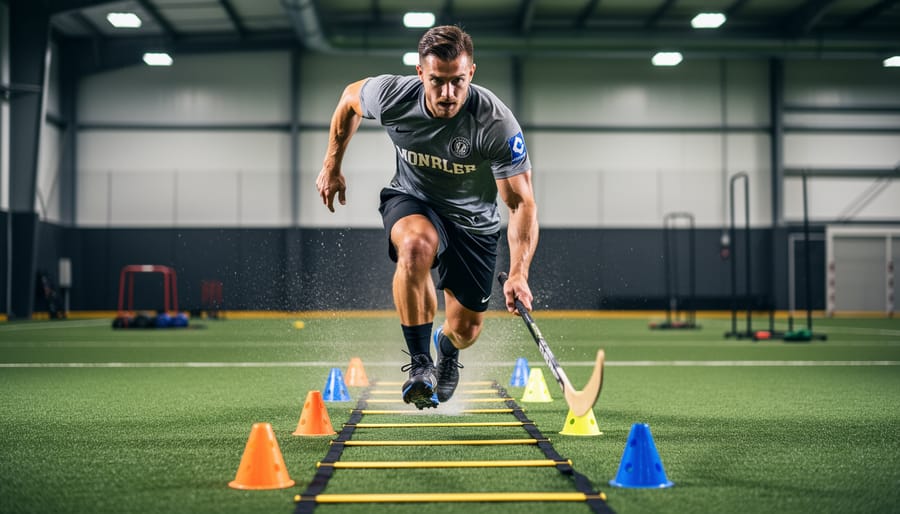
Plyometric exercises form the foundation of off-ice speed training. Box jumps, broad jumps, and lateral bounds build the explosive power needed for quick starts and direction changes. Start with basic box jumps at 12-18 inches, focusing on landing softly with knees aligned over toes. Progress to single-leg variations as your stability improves. Broad jumps develop horizontal power that directly translates to forward skating acceleration. Aim for 3-4 sets of 5-8 repetitions, prioritizing quality over quantity. Your muscles should feel explosive, never sluggish or fatigued.
Lateral movement drills deserve special attention because hockey demands side-to-side agility that few other sports require. Lateral shuffles across 10-15 yards teach you to maintain a low athletic stance while moving sideways. Keep your chest up and push off the outside edge of your driving foot. Skater jumps add a power component to lateral movement, mimicking the weight transfer you use while skating. Cone drills that require tight pivots and direction changes challenge your ability to decelerate and re-accelerate quickly.
First-step quickness separates average players from elite ones. Resistance band sprints develop that initial explosive drive. Attach a resistance band around your waist and sprint forward for 10-20 yards while a partner provides tension. Your forward lean and driving knee action should mirror your skating stride. Sprint starts from various positions (standing, kneeling, lying down) train your nervous system to fire quickly from any situation you might encounter during a game.
| Training Phase | Primary Focus | Key Exercises |
|---|---|---|
| Off-Season | Power Development | Box jumps, broad jumps, resistance sprints |
| Pre-Season | Multi-Directional Speed | Lateral bounds, cone drills, agility ladders |
| In-Season | Speed Maintenance | Sprint starts, skater jumps, light plyometrics |
This progression ensures you build maximum power during the off-season when recovery time is abundant, then maintain that speed throughout the competitive season without overtaxing your body.
Change-of-direction work requires dedicated attention. Set up T-drills, pro agility shuttles, and 5-10-5 drills that force you to plant, pivot, and explode in new directions. Time yourself regularly to track improvements. Most players see noticeable gains within 4-6 weeks of consistent training, typically shaving 0.2-0.4 seconds off their agility times.
Flexibility and Mobility Work for Injury Prevention
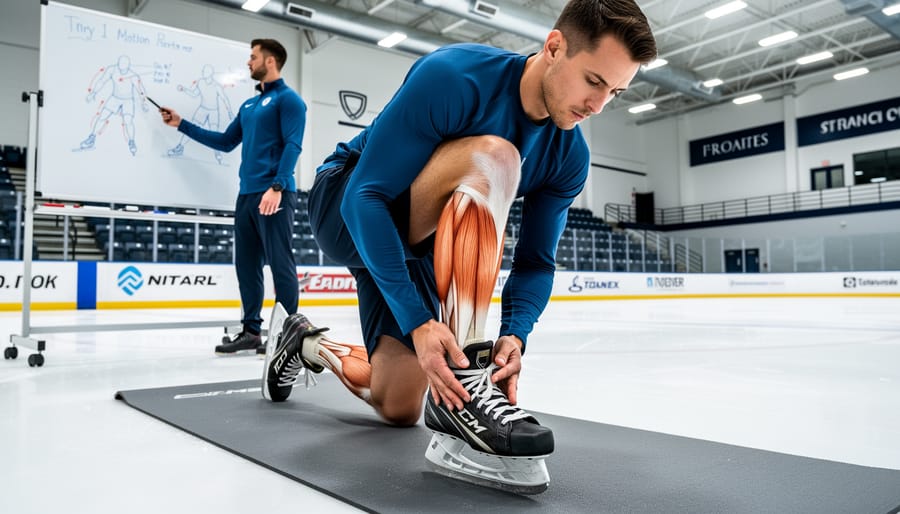
Your body’s ability to move through full ranges of motion directly impacts your skating mechanics and determines how long you can play injury-free. Hockey demands extreme hip mobility for deep skating strides, ankle flexibility for proper knee bend, and shoulder range of motion for powerful shots and checks. Without addressing these areas consistently, you’re setting yourself up for groin strains, hip flexor issues, and shoulder problems that sideline players every season.
Start every training session and game with a dynamic warm-up that prepares your body for hockey-specific movements. Leg swings (front-to-back and side-to-side), walking lunges with rotation, and inchworms activate the muscles you’ll use on the ice. Spend 8-10 minutes moving through these patterns to elevate your heart rate and take your joints through their full range. This isn’t optional. Players who skip dynamic warm-ups are significantly more likely to pull muscles during those first explosive shifts.
Your hips require special attention because skating forces them into positions most daily activities never approach. Perform 90/90 hip stretches, pigeon pose variations, and frog stretches at least four times weekly. Hold each position for 60-90 seconds, breathing deeply to allow the muscle tension to release. For ankles, practice deep squat holds and use ankle mobility drills against a wall to improve your skating stance.
Save static stretching for after workouts or games when your muscles are warm and you’re focused on recovery. Target your hip flexors, hamstrings, and quadriceps with sustained holds of 30-45 seconds per side. Many players benefit from adding yoga or dedicated mobility sessions on off-days to address accumulated tightness.
Shoulders need both stability and mobility. Perform arm circles, band pull-aparts, and sleeper stretches to maintain healthy shoulder function through the physical demands of hockey. The investment in mobility work pays dividends in career longevity and consistent performance.
Structuring Your Training Throughout the Season
Your training program needs to evolve throughout the year, matching your physical preparation to the demands of each season. Think of it like shifting gears in a car. Push too hard for too long and you’ll burn out before playoffs. Coast through the off-season and you’ll spend half the year playing catch-up.
The off-season is your foundation period. This is when you build the strength, power, and conditioning base that will carry you through the grueling months ahead. You have time to lift heavy, train hard, and recover fully between sessions. Focus on maximal strength development with lower rep ranges (3-5 reps) and higher loads. Your conditioning work can be intense but doesn’t need to mimic game situations perfectly. Volume is high because you have the recovery time to support it.
| Season Phase | Primary Focus | Training Volume | Intensity |
|---|---|---|---|
| Off-Season (May-August) | Maximal strength, aerobic base, muscle building | High (5-6 days/week) | Moderate to High |
| Pre-Season (September-October) | Power conversion, speed, sport-specific conditioning | Moderate (4-5 days/week) | High |
| In-Season (November-March) | Strength maintenance, power, recovery | Low (2-3 days/week) | Moderate |
| Playoffs (April) | Maintain peak performance, injury prevention | Minimal (1-2 days/week) | Low to Moderate |
As pre-season arrives, shift your emphasis toward converting that raw strength into explosive power. Your rep ranges move to 3-6 repetitions with lighter loads moved as fast as possible. Conditioning becomes more hockey-specific with interval work that mirrors shift lengths. Training volume decreases slightly as on-ice practices increase.
Once the season starts, your primary goal is maintaining what you’ve built while managing fatigue. Two to three quality gym sessions per week will preserve strength without leaving you drained for games. Keep the movements fundamental: squats, deadlifts, presses, and explosive work. Drop the accessory exercises that don’t give you much return on investment.
During playoffs, less is more. One strength session per week focused on neural activation rather than muscle breakdown keeps you sharp. Your body is already stressed from high-stakes games. Give it what it needs to recover and perform, not another reason to be sore.
The biggest mistake players make is training like it’s July in the middle of January. Respect the season, adjust your approach, and you’ll stay healthy while your competitors break down.
Expert Insights: What Top Training Specialists Recommend
We spoke with three experienced hockey strength coaches to get their take on what players should focus on and where training often goes wrong.
Mike Denardo, who’s worked with junior and collegiate hockey programs for over 15 years, points to a widespread problem: “Players spend too much time doing bodybuilding-style workouts that don’t translate to the ice. I see kids doing bicep curls and chest flys, but ask them to do a proper lateral lunge and they fall apart. Hockey demands single-leg strength and lateral power that traditional gym exercises just don’t address.”
His top overlooked exercise? The split-stance Romanian deadlift. “It builds posterior chain strength while challenging balance. That combination is exactly what you need for powerful skating strides.”
Sarah Chen, a certified strength coach who trains youth and elite-level players, sees mobility work getting skipped constantly. “Everyone wants to lift heavy and get faster, but they ignore the hip mobility that actually allows proper skating mechanics. I make every player I work with spend 10 minutes on hip CARs and adductor stretches before touching a weight.”
For younger players aged 10-14, she emphasizes mastering bodyweight movements first. “Learn to control your own body through lunges, pushups, and planks with perfect form. Adding weight before you have that foundation just builds bad patterns.”
Coach Tom Bergstrom, who’s trained several NHL players, addresses the cardio mistake he sees repeatedly. “Players think they need to run for miles or do hour-long bike sessions. Hockey shifts last 45 seconds. Your conditioning should reflect that reality. High-intensity intervals that mimic game demands will serve you far better than steady-state cardio.”
His advice for advanced players focuses on intention: “Every rep should have a purpose. Are you moving explosively? Are you maintaining tension through the full range? Quality beats quantity every single time.”
All three coaches agreed on one final point: consistency trumps perfection. Missing workouts regularly does more damage than having an imperfect program you actually follow.
Effective training for hockey players requires a different approach than standard gym routines. Generic fitness programs miss the explosive movements, rapid direction changes, and anaerobic demands that define the sport. The exercises and programming outlined in this article address these specific requirements, giving you the tools to build strength, speed, and stamina that directly translate to better performance between the boards.
Progress doesn’t happen overnight. Start with movements you can execute properly, then gradually increase intensity and complexity. A poorly performed Olympic lift won’t help your skating stride, but bodyweight exercises done correctly will build the foundation you need. Your body adapts to consistent, progressive challenge over time.
Remember that on-ice skill development and off-ice preparation aren’t separate pursuits. They work together. The lateral strength you build in the weight room makes your crossovers more powerful. The mobility work you do allows you to maintain proper positioning in board battles. The conditioning you develop keeps your hands quick in the third period when fatigue sets in.
Plan your training around your season. Build strength in the off-season, maintain it during competition, and address weaknesses when your schedule allows. Track your numbers, monitor recovery, and adjust as needed.
Take what you’ve learned here and put it into practice. Choose three exercises to start this week. Schedule your sessions. Commit to the process. Your performance on the ice will reflect the work you put in away from it.