
Basketball serves as one of the most effective cross-training tools for hockey players during the off-season, building explosive power, lateral quickness, and cardiovascular endurance that translate directly to faster skating and sharper on-ice movement. A structured 8-12 week basketball training program, requiring only access to a court and proper footwear, can improve your first-step acceleration by 15-20% while maintaining the competitive intensity that keeps you sharp between hockey seasons.
The connection isn’t obvious at first glance. Hockey happens on ice with blades and sticks, while basketball unfolds on hardwood with sneakers and a ball. But dig deeper and you’ll find the movement patterns overlap remarkably well. The quick directional changes, stop-and-start sprints, and constant need to read opponents mirror what happens during a shift. Your hip flexors, glutes, and core fire in similar sequences whether you’re defending a forward driving the lane or staying with a winger cutting to the net.
What makes basketball particularly valuable is the built-in intensity. Unlike running drills or gym circuits, the competitive nature of pickup games or structured play pushes you harder without feeling like punishment. You’re chasing wins, not just clock time, which means your conditioning work doubles as mental training for reading plays and making split-second decisions under pressure.
The approach outlined here gives you a complete roadmap: the gear you need, how to safely ramp up volume without injury, a week-by-week progression plan, and specific benchmarks to confirm you’re actually getting faster and more explosive. By the time training camp arrives, you’ll step on the ice noticeably quicker in every direction.
Why Basketball Works for Hockey Off-Season Training
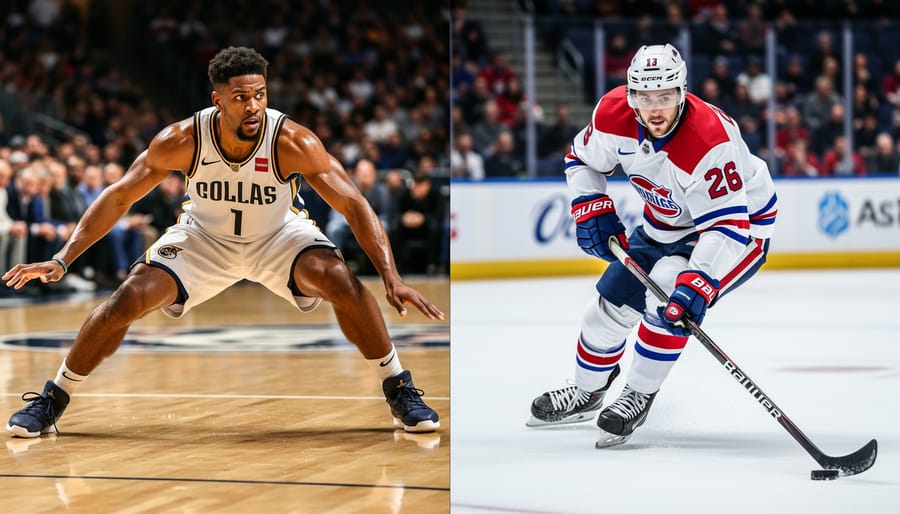
Basketball isn’t just a convenient way to stay active when the rink is closed. It delivers measurable improvements in the exact physical qualities that separate dominant hockey players from average ones, and research in cross-sport training confirms why this combination works.
The movement demands of basketball mirror hockey’s most critical patterns. Defensive slides on a basketball court replicate the lateral shuffles you use to maintain gap control on the ice. Quick changes of direction while pursuing a fast break train the same neuromuscular pathways you activate when transitioning from backward to forward skating. Because basketball happens on your feet rather than skates, you develop raw movement competency that translates to hockey once you’re back on the ice.
The cardiovascular conditioning basketball provides matches hockey’s interval-based energy demands remarkably well. A typical basketball possession lasts 15-24 seconds of high-intensity effort followed by brief recovery periods, nearly identical to the average hockey shift. This work-to-rest ratio trains your anaerobic and aerobic systems simultaneously, building the capacity to sustain explosive effort throughout a game.
Basketball delivers these specific advantages for hockey players:
- Explosive power development through repeated jumping, cutting, and sprinting without skating-specific overuse
- Enhanced hand-eye coordination from tracking and controlling a ball in dynamic situations
- Improved spatial awareness and peripheral vision during fast-paced gameplay
- Decision-making under pressure with constantly shifting defensive coverage
- Reduced risk of hockey-specific overuse injuries by varying movement patterns and joint angles
The mental benefits matter just as much. Reading defensive positioning, anticipating passes, and executing under fatigue create cognitive demands that carry over directly to game situations on the ice. You’re training your brain to process information quickly while your body is under stress.
Cross-sport training works because your body adapts to novel stimuli differently than familiar movements. Basketball challenges muscles, tendons, and movement patterns that skating alone doesn’t fully develop, creating a more resilient, well-rounded athlete.
Equipment and Space You’ll Need
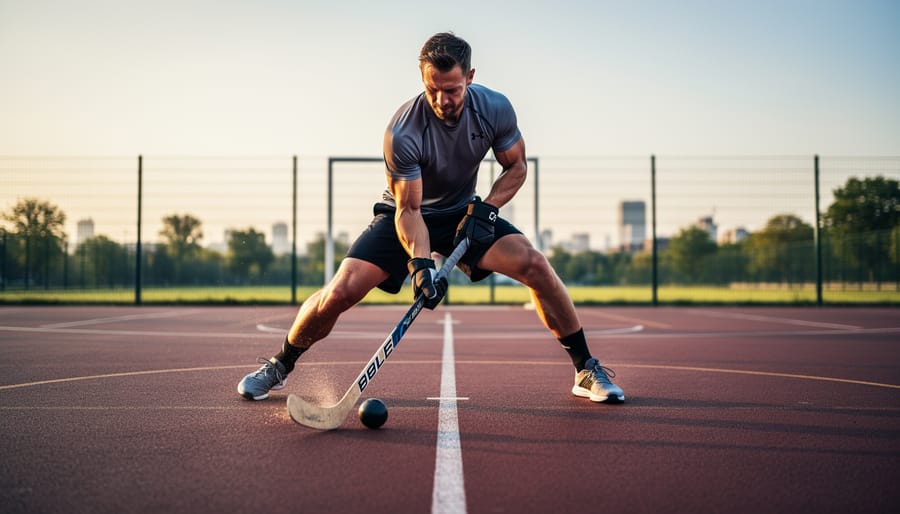
You don’t need an elaborate setup to start basketball training. A regulation-size basketball (men’s 29.5″, women’s 28.5″) is your primary tool, buy one that’s properly inflated and suited to your hand size. Pair it with basketball shoes that provide ankle support and court traction; running shoes won’t cut it on hardwood or asphalt surfaces where lateral movements demand stability.
Court access varies by budget and location. Indoor facilities offer consistent conditions year-round, while outdoor courts work fine for most drills and cost nothing. Many community centers and schools open courts during off-hours. If you’re investing in broader training equipment consider items that serve multiple purposes beyond basketball.
Essential additions include six to eight training cones (around $15) for agility work and a basic agility ladder ($20-30) for footwork drills. A heart rate monitor helps track conditioning intensity and ensures you’re working in zones that translate to hockey fitness, chest straps are more accurate than wrist-based options.
Optional but useful: resistance bands ($15-25) add strength work between court sessions, a jump rope provides quick warm-ups anywhere, and a foam roller aids recovery. For detailed comparisons of fitness tools, check this buying guide focused on hockey-specific needs.
Budget-conscious players can start with just a ball, shoes, and free court access, total outlay under $100. Add equipment gradually as you commit to the program. The court itself matters more than fancy gear; consistent access to space where you can move freely beats owning every training tool but rarely using them.
Safety Considerations and Injury Prevention
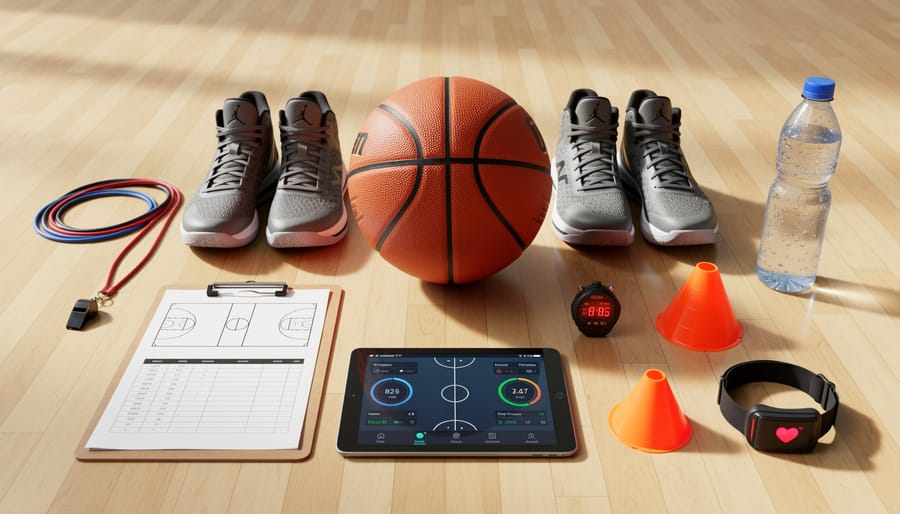
Cross-training brings tremendous benefits, but only when you respect your body’s limits and the differences between basketball and hockey movements. The explosive lateral cuts and vertical jumps that make basketball so effective for conditioning also create injury risks if you transition too quickly from ice-based training.
Start every basketball session with a dynamic warm-up targeting ankles, knees, and hips. Spend 10-12 minutes on leg swings, walking lunges, high knees, lateral shuffles, and ankle circles before touching a basketball. Your body needs time to adapt to court surfaces, concrete and hardwood demand different stabilization than ice, placing new stress on ankles and knees accustomed to skating mechanics.
Ankle injuries represent the most common basketball setback for hockey players. The constant pivoting, jumping, and sudden direction changes expose ankles to sprains, especially during your first two weeks on court. Invest in proper basketball shoes with ankle support, not running shoes or worn-out trainers. If you’ve had previous ankle injuries, consider lace-up braces during early sessions until your stabilizer muscles strengthen.
Recovery days aren’t optional in cross-training programs. Schedule at least two full rest days weekly, and never run basketball sessions on consecutive days during your first month. Your muscles, tendons, and connective tissues need 48-72 hours to adapt to basketball’s impact forces.
Hydration demands shift dramatically from ice to court. You’ll sweat two to three times more during basketball compared to skating in cold arenas. Drink 16-20 ounces of water two hours before each session, sip throughout training, and monitor urine color, pale yellow indicates proper hydration. If you feel dizzy, experience muscle cramps, or notice declining performance mid-session, you’re likely dehydrated.
Listen to your body’s signals about training modifications. Persistent fatigue, elevated resting heart rate, or decreased motivation all indicate you need to scale back intensity or add an extra recovery day.
Your 8-Week Off-Season Basketball Training Plan
Weeks 1-2: Foundation and Movement Patterns
Your first two weeks lay the groundwork for everything that follows. Start slowly, your body needs time to adapt to the different movement patterns, surface friction, and foot positioning basketball demands compared to skating.
Ball-Handling Foundation
Begin each session with 10 minutes of stationary ball-handling drills. Practice dribbling with your right hand for 30 seconds, then your left, keeping your head up and eyes forward just as you would scanning the ice. Progress to figure-eight dribbles through your legs (3 sets of 10 reps) and crossover dribbles (2 minutes continuous). These drills build the hand-eye coordination that translates directly to stickhandling and puck control.
Defensive Slide Progression
Defensive slides mirror the lateral movements you use in gap control and defensive positioning on ice. Set two cones 15 feet apart. Start in an athletic stance, knees bent, chest up, feet wider than shoulder-width. Slide laterally from cone to cone without crossing your feet, maintaining low hip position. Complete 3 sets of 8 slides each direction with 60 seconds rest between sets. By week two, increase to 4 sets and reduce rest to 45 seconds.
Change-of-Direction Drills
Place four cones in a square pattern, 10 feet apart. Sprint forward to the first cone, shuffle laterally to the second, backpedal to the third, shuffle back to start. That’s one rep. Complete 5 reps with 90 seconds recovery between each. These multidirectional movements build the agility base you’ll need for quick transitions on ice.
Finish each session with 10 minutes of light shooting practice to maintain elevated heart rate while developing touch and timing.
Weeks 3-4: Power and Explosive Movement
By week three, you’ve built the movement foundation. Now it’s time to add explosive power that translates directly to your hockey game.
Basketball’s jumping and sprinting demands make it perfect for developing the explosive strength hockey players need for quick starts, board battles, and chasing down loose pucks. These two weeks focus on plyometric movements that build power through your hips, legs, and core.
Start each session with jump shot drills that emphasize vertical explosion. Set up at five spots around the key, taking jump shots from each position. The goal isn’t perfection, it’s launching yourself explosively off both feet, landing under control, and repeating. Aim for three sets of 15 jumps per session. This mirrors the explosive hip extension you need when accelerating from a standstill on the ice.
Rebounding drills take this further. Position yourself under the basket and execute continuous tip drills: jump, tap the ball against the backboard, land, and immediately explode back up. Perform sets of 10-12 consecutive jumps with 90 seconds rest between sets. Complete four sets. This repetitive explosive work builds the leg power you need for winning board battles and maintaining body position through contact.
Fast break drills combine power with speed endurance. Sprint baseline to baseline, finishing with an explosive layup. Walk back and repeat. Start with six sprints, building to ten by week four. Focus on your first three steps, that explosive acceleration matches what you need when breaking toward the puck or chasing a breakaway.
Rest 48 hours between these power sessions to allow full recovery.
Weeks 5-6: Conditioning and Game Simulation
By weeks five and six, you’re ready to push conditioning through live play. Small-sided games deliver the high-intensity interval work that mirrors hockey shift patterns, short bursts of maximum effort followed by active recovery. This is where basketball training directly translates to on-ice stamina.
Start with 2-on-2 half-court games. Play four-minute segments with two minutes of active rest between rounds. These shorter games force constant movement without the strategic lulls of full-court 5-on-5. You’ll defend, sprint to offense, and battle for position continuously, exactly the demand pattern of a hockey shift. Run four to six rounds per session, tracking your heart rate throughout.
Progress to 3-on-3 full-court by mid-week six. The added player and extended court create more complex decision-making under fatigue, challenging your mental processing when your legs are burning. Set up three-minute games with 90-second recovery periods. Aim to keep your heart rate between 80-90 percent of maximum during play, dropping to 60-70 percent during rest intervals.
Track your recovery time between games. Can you drop from 165 beats per minute to 120 within that 90-second rest? Faster recovery signals improved conditioning that carries directly to shorter recovery times between shifts on ice.
Mix competitive scrimmages with constraint-based games, only three dribbles allowed, or you must pass before shooting. These modifications prevent skilled players from dominating while increasing the conditioning demand for everyone. The constant movement without the ball mimics off-puck hockey work, where positioning and anticipation matter as much as possession.
Weeks 7-8: Sport-Specific Transfer and Maintenance
By weeks seven and eight, you’re ready to extract maximum hockey value from your basketball training while gradually transitioning back to ice-focused work. This phase emphasizes drills with direct on-ice application and introduces tapering principles as pre-season approaches.
Your defensive slide work should now mirror gap control situations. Set up cone patterns that replicate backing up against a forechecking opponent, then explosively closing space. Practice maintaining hip position and balance through direction changes, the same mechanics you’ll use when defending odd-man rushes. Execute three sets of 30-second defensive slide sequences with 90 seconds rest, focusing on controlled hip rotation and quick feet rather than speed alone.
Explosive cutting drills simulate skating transitions perfectly. Practice hard plants followed by immediate acceleration in the opposite direction, replicating the forces your legs generate during tight turns on ice. Sprint to the three-point line, plant your outside foot, and explode back toward the baseline. This mimics the deceleration-acceleration pattern of pivoting away from pressure or transitioning from offense to defense. Complete five sets of four cuts per direction.
Hand-eye coordination work becomes crucial now. Incorporate tennis ball tosses against a wall while performing defensive slides, or practice catching and releasing a basketball during lateral movements. These challenge your visual tracking and hand speed under movement stress.
Reduce basketball session frequency to twice weekly during week eight, shortening sessions to 30 minutes. This controlled taper prevents fatigue as you ramp up ice time, ensuring your improved athleticism translates smoothly back to hockey-specific performance.
Sample Weekly Training Schedule
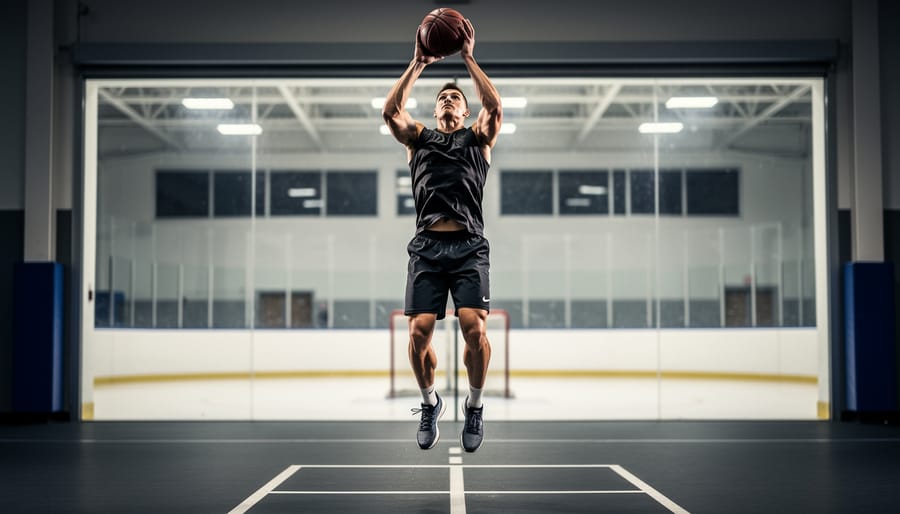
Here’s a balanced weekly framework that fits basketball training into your broader off-season program without burning you out.
Monday: Basketball Skills (60 minutes, moderate intensity)
Work on fundamental skills like ball-handling, defensive slides, and change-of-direction drills. Keep your heart rate in the 60-70% max zone. This session builds movement literacy without excessive fatigue.
Tuesday: Strength Training (45-60 minutes)
Hit the gym for lower-body and core work. Focus on compound movements that support both sports: squats, deadlifts, lunges, and rotational core exercises. Leave the court work behind today.
Wednesday: Basketball Conditioning (45 minutes, high intensity)
Run small-sided games or interval drills that push your heart rate to 75-85% max. Think three-on-three scrimmages or timed fast-break sequences. This mimics hockey shift intensity.
Thursday: Active Recovery
Light movement only. Swim, bike easily, or do mobility work. Your body needs this day to adapt and rebuild.
Friday: Combination Session (75 minutes total)
Start with 30 minutes of strength training focusing on upper body and power movements. Follow with 45 minutes of basketball shooting drills and plyometric work. Split the intensity between the two activities.
Saturday: Basketball Game Play (60-90 minutes, variable intensity)
Join a pickup game or organized run. Let the flow dictate intensity. This applies everything you’ve practiced while keeping training fun.
Sunday: Complete Rest
No structured activity. Recovery matters as much as the work itself.
Adjust volume based on your response. If you’re consistently sore beyond 48 hours or your performance drops across sessions, dial back one basketball day or reduce session length by 15 minutes. Complement this schedule with appropriate training tools like agility ladders and resistance bands during your basketball work.
Measuring Progress and Adjusting Your Plan
Tracking your progress objectively helps you determine whether basketball training is actually improving your hockey performance, and when to adjust your approach. Start by establishing baseline measurements before you begin, then retest every two weeks to monitor improvement.
The most relevant benchmarks for hockey players include lateral agility times (pro-agility shuttle or 5-10-5 drill), vertical jump height, resting heart rate, and recovery heart rate after high-intensity intervals. Record your pro-agility time by placing three cones five yards apart; sprint to the right cone, touch the line, sprint ten yards to the left cone, then sprint back through the middle. Hockey players typically target times under 4.5 seconds. For vertical jump, measure your standing reach against a wall, jump as high as possible, and mark the difference, improvements of 2-3 inches over eight weeks indicate solid power gains. Track your resting heart rate first thing each morning; a gradual decrease of 5-10 beats per minute suggests improved cardiovascular fitness.
Beyond numbers, ask yourself these questions weekly: Am I recovering fully between sessions? Do I feel explosive on the court? Can I maintain intensity through the final quarter of scrimmages? If you’re consistently fatigued, experiencing joint pain, or seeing performance decline rather than improve, you’re likely overtraining. Cut your basketball frequency from four sessions to two or three per week and prioritize sleep.
Signs you’re ready to transition back to in-season hockey training include maintaining your target heart rate recovery (returning to below 120 bpm within two minutes after high-intensity work), feeling confident in lateral movements without conscious thought, and completing Week 8 workouts without excessive fatigue. If measurements haven’t improved by Week 4, examine your nutrition, sleep quality, and whether you’re pushing intensity during sessions, going through the motions won’t create adaptation. Adjust session length, reduce rest periods, or increase game-speed work to create the stimulus your body needs.
Common Questions About Basketball Cross-Training
Can basketball replace on-ice training during the off-season?
No, basketball is a complementary training tool, not a replacement for hockey-specific skills. While it builds transferable fitness and movement qualities, you’ll still need some ice time (typically one to two sessions per week) to maintain your skating mechanics, edge work, and puck handling during the off-season.
How much basketball training is too much?
More than three to four basketball sessions per week can lead to overtraining and interfere with recovery, especially when combined with strength work and on-ice sessions. Watch for persistent soreness, decreased performance, or elevated resting heart rate as signs you need to scale back volume.
Should goalies train differently with basketball?
Yes, goalies benefit most from modified drills that emphasize lateral movement, quick-reflex catching, and explosive push-offs rather than full-court running. Focus on defensive slides, reaction drills with partners, and short-burst movements that mirror the demands of the crease.
When should I stop basketball and transition back to full hockey training?
Begin tapering basketball two to three weeks before your hockey pre-season starts, reducing volume by half while maintaining one light session per week. This allows your body to adapt back to ice-specific movement patterns without losing the conditioning gains you’ve built.
Is pickup basketball enough, or do I need structured training?
Pickup games provide excellent conditioning but lack the progressive overload and targeted skill development of structured training. For optimal results, combine one to two structured sessions weekly with a pickup game, ensuring you’re addressing specific movement patterns rather than just playing casually.
How do I maintain the skills I’ve developed through basketball?
Once your hockey season starts, drop to one 30-minute basketball session every week or two focused on lateral movement drills and quick-reflex work. This maintenance dose keeps the neural pathways active and preserves your conditioning without interfering with your primary sport.
Beyond these common concerns, understand that basketball cross-training works best when you treat it as part of a larger system rather than a standalone program. Your off-season should balance multiple training elements: strength work in the gym, limited on-ice sessions for skill maintenance, basketball for movement quality and conditioning, and adequate recovery time. The players who get the most from basketball are those who approach it with specific intent, not just as casual recreation.
Pay attention to how your body responds across different surfaces. Court work creates different impact patterns than ice, which can initially cause shin, knee, or ankle soreness as your body adapts. This adaptation process is part of the training benefit, but it requires smart progression. If you experience sharp pain rather than general muscle fatigue, back off the volume and allow more recovery between sessions.
Your basketball training should also evolve with your hockey development. Younger players might use it primarily for general athleticism and movement literacy. More advanced players can focus on specific qualities like first-step explosiveness or decision-making speed that directly translate to high-level hockey situations. Adjust the drill selection and intensity based on what your game needs most, not just what you enjoy doing on the court.
Basketball training offers hockey players a proven path to off-season development when approached with structure and purpose. The eight-week framework outlined here isn’t arbitrary, it respects the physiological principles of periodization that separate genuine improvement from random activity. By treating basketball as targeted cross-training rather than casual recreation, you build complementary skills that translate directly to the ice while giving hockey-specific movement patterns time to recover.
The key distinction matters: off-season training develops new capacities (power, lateral agility, cardiovascular base), while in-season work maintains what you’ve built. Basketball excels in the development phase because it challenges your body differently than skating, reducing overuse injury risk while strengthening the same explosive, multi-directional movement patterns hockey demands.
Start your plan with clear objectives. Track your progress through measurable benchmarks. Adjust intensity based on how your body responds, not ego or impatience. The basketball court becomes a laboratory for building a better hockey athlete, stronger first steps, quicker transitions, deeper conditioning reserves.
When you return to the ice, you’ll notice the difference in your skating efficiency, your ability to repeat explosive efforts shift after shift, and your confidence in tight spaces. That’s the payoff of structured off-season work.